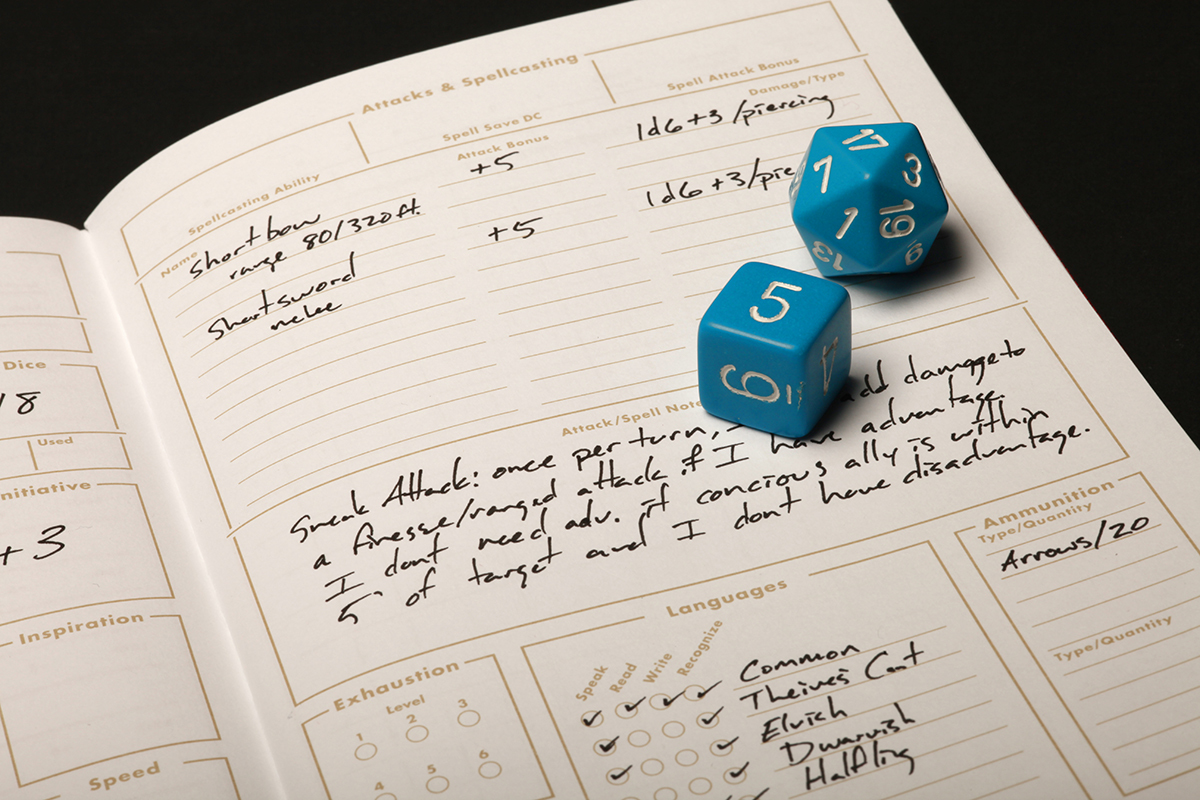
A few years ago, a friend of mine introduced me to the tabletop role-playing game Dungeons and Dragons. You might have heard of it once or twice, or even seen it portrayed in popular media, like on the Netflix show Stranger Things, where the kids play the game and even name some of the monsters that they fight from Hawkins Lab after monsters from the game.
I’m aware that writing this blog is pretty much exposing myself for the huge nerd that I am. Yes, this game is really nerdy. No argument that I can come up with is going to be able to change that fact. But what can I say? It’s also really fun. And I think that it has a lot of value besides just being a fun game.
The thing that really drew me to the game was the idea that this is a collaborative story. To give you just a more specific look at how the game is played, one person is assigned as the GM (game master) and the other players (could be as little as one, or as many as…however many you want,) create characters that they roleplay as within the story. The GM will come up with the general outline of a story that he wants to tell and facilitate the rules and mechanics of the session, and the other players roleplay characters within that story, deciding together the details of what exactly happens, when, and why. These stories could be literally anything. The game itself is based in a fantasy setting, think Lord of the Rings, but at the end of the day, it’s really any story that you want it to be. Evil Sorcerer wants to resurrect an ancient evil force to destroy the world and the players have to stop him? Sure. Players want to stop a tyrant king Robin Hood style by stealing from aristocrats and giving it back to the poor? You bet. Want to try to steal a dragon’s stash of gold and end up having to fight it instead?
You get the point. When I say anything, I mean anything. This also goes for your characters. Want to be a sorcerer? Sure. War veteran? Got it. Assassin with a dark past? Okay, if you must.
And like I said, there are rules and structure to guide how you are able to act within the game. That part is fixed, you can’t just do ANYTHING you want. But in terms of narrative and story, that decision is shared between the GM and the players, and it truly is pretty much limitless.
Because stories take several sessions from start to finish, these roles are set in stone for a particular “campaign,” which is essential just a story. All of the players will meet up to play for a particular session, which is just like a chapter out of a book, and in that session, they will continue the story that they’ve been playing.
You’re probably wondering at this point why I’m writing this blog post and what does it have anything to do with our class? Well, a large portion of this classes discussion has been on literacy, the ways people use literacy to their advantage, the ways people acquire literacy, even questions surrounding what exactly is literacy? Another large portion I’d say has been on discussions surrounding the diversity of writing, and all the different forms that writing can take. Looking at these two topics together helps us to better understand both how literacy is acquired and used.
Because D&D is a game that is really limitless in possibilities, and while it has rules, mechanics that make the game function smoothly, the stories that you get to generate have no boundaries. You can do whatever your imagination comes up with, and that in my opinion is what makes the game so fun. You could play it hundreds of times and never do exactly the same thing, because you have the ability to come up with a different story every time that you play.
This got me thinking, could D&D possibly be a way for people to acquire/practice literacy skills? Further than that, does it have the potential for being a way to develop your own unique writing style and voice in an environment that is supportive? I’d like to say yes for both of those questions, and here is my reasoning why.
If you are the GM, that means that the general guideline of the story and where it should go is up to you. You plan out what exactly “could” happen in a given session, and this takes some work! In a game where anything can happen, and the players have an equal share in what could happen, you have to be prepared for things to go awry, and they will go awry. You won’t write down every possible scene, every possible dialogue line that will happen, every minute detail, but you will have to plan and have some things in mind. I current am the GM of a game for a group of friends, and I do a lot of writing of certain ideas that I have, and reading the ideas of others on the internet. This amounts to a lot of time spent reading and writing for the game behind the scenes, and the writing can be anything from short little notes, to fleshed out backstories of specific characters that you want to include. It’s as little or as much as you want, and this ability to be detailed and to write and read and prepare I think makes it an excellent means of collaborative storytelling. It’s like planning for a night of improv skits, only the actors sit at a table and tell stories in voices and description of actions.
The same kind of preparation goes for if you are a player. I’ve had friends write me really detailed character descriptions, and even sometimes send me short creative writing pieces about their characters to give a perspective of what they are like before we play. Some of these people that I’m personally friends with don’t really particularly like reading fiction, didn’t like English class, weren’t into theater, didn’t journal or write creatively at all, and the writing that they produced was honestly really good. You could hear that they had an investment in it and spent time on it. To them it really wasn’t labor intensive, it was just fun, and what they wrote was incredibly detailed and exciting.
During games, both the GM and the players have to roleplay as characters. That doesn’t mean you have to dress up as a warrior from the middle ages and run around in the woods pretending to fight monsters (although some people do actually do that, look it up, it’s called Live Action Role Playing) but it does mean that at certain points you’ll speak as your character, and you’ll tell the other players what your character wants to do in terms of action/reactions. Having conversations and creating a story on the fly is difficult to do, and people that are actors or are good at improvisatory acting excel at this. But for most people, it’s hard to talk and think like someone else! But it allows you someone to think of different ways to say things, or to think not how they would say it in that instance, but how someone else could or would. It’s an exercise in both building a narrative and conversation skills, something that I think helps to develop a style of storytelling, and can also be useful for those who want to build skills in literacy. Having improv like dialogue situations with friends allows you to learn I think in an environment that is judgement free.
At the end of all of this, you might think that you don’t want to make a story and roleplay in a fantasy world. And that’s fine, because there are so many other roleplaying games out there that are so similar to the premise of DND. I played a game once where you roleplayed characters in a randomly generated Cohen brother-esque scenario where everything goes horribly wrong. It was hilarious. And the same kind things I discussed before can apply here. The setting doesn’t matter, but the literacy building skills and story telling that occurs in these kinds of game do.
The point of this blog I suppose becomes a love letter to tabletop roleplaying games. They’ve brought me a lot of fun times with friends, and I think they can genuinely be a moment where literacy skills are developed and passionate, personal writing can occur. So if you love to write and to tell stories, consider looking into the game, maybe tell your friends. Who knows, you might have a really good time.
 Tom Talks (and Learns) About Writing
I want to introduce you to this SJC English graduate alum!: https://www.timmwoods.com/
LikeLiked by 1 person
That is so cool! I definitely would love to reach out to him and see what his experiences have been like doing the work that he does.
LikeLike
Hi Tom,
I loved this Blog and I’m glad I came across it. I used to play D&D with my cousins and my brother (who went through the phase and bought all the books). Since he got out of the phase I don’t know where to put the books! Its great how you explained how to play and the different roles. Don’t worry it’s not really exposing yourself as a huge nerd. D&D is pretty fun to play if you have the time. It was a great idea to link the game with literacy skills. When you are GM you basically have to plan out what happens next. Plus when you’re in character you are basically a new person so you have to talk a certain way and have improve dialogue. It’s nice to hear that there are D&D players at St. Johns. I hope you guys don’t go too far and bring your character outfits to school so you can play in the dorms or in a room in MAR. That would be pretty interesting to walk in on.
LikeLiked by 1 person